The Liberal Arts Approach to Teaching with AI
In June of 2025, Manolis Kaparakis, director of the Hazel Quantitative Analysis Center (QAC) at Wesleyan, reached out to colleagues at peer liberal arts institutions to ask if they would join him in organizing a workshop on artificial intelligence (AI) and learning, with a particular focus on data science. The deadline to submit a proposal to The Alliance to Advance Liberal Arts Colleges for funding such a workshop was fast approaching. His colleagues agreed and that fall they were awarded a grant to fund the workshop. Last July, the three-day workshop took place on Wesleyan’s campus.
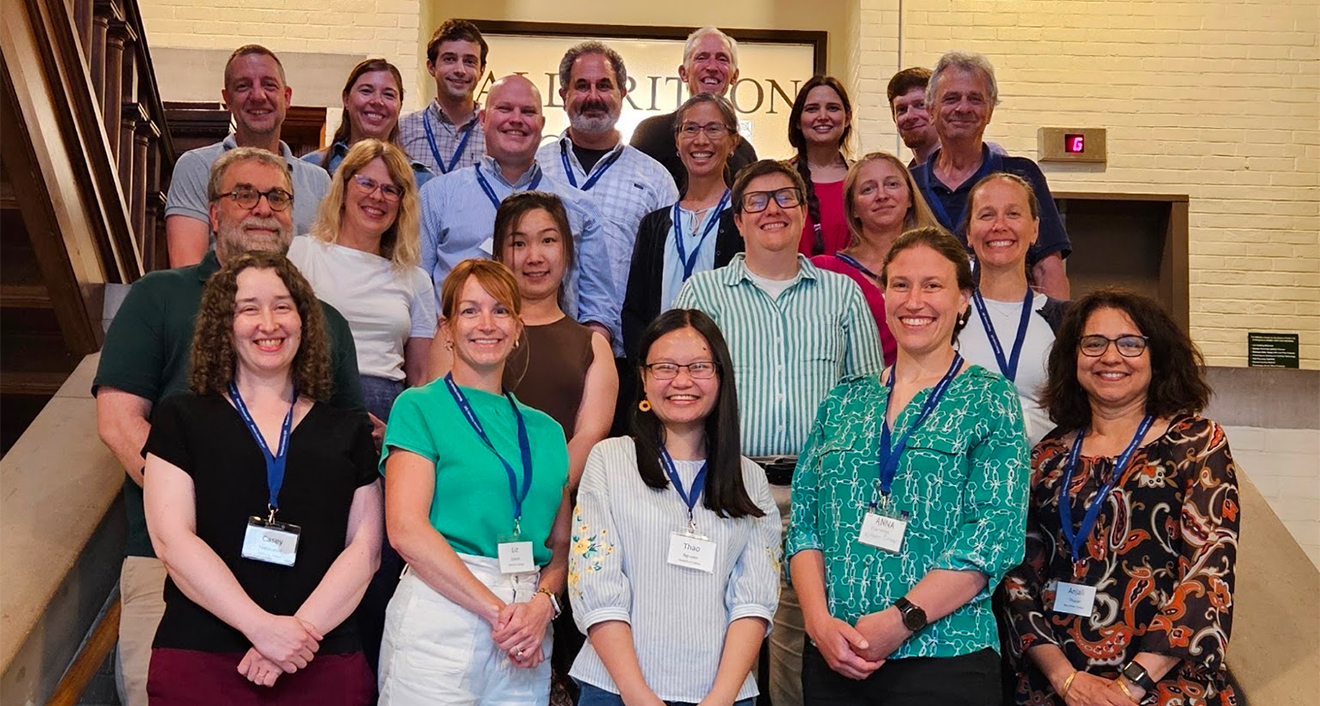
During the gathering of scholars from nearly a dozen institutions of higher education, faculty homed in on their growing concerns about AI’s impact on student learning. “The concern we all have is that we don't end up dealing with what everybody calls ‘cognitive atrophy,’” said Kaparakis. “We don't want to see cases where essentially the learning process is outsourced to some probabilistic models.”
Kaparakis and his colleagues were seeing issues with AI use in both introductory and advanced courses. Novice students were “offloading” basic learning activities to AI tools instead of engaging in those activities independently. In one case, students worked on an assignment involving regression models—a statistical method that analyzes the relationship between variables. They earned perfect scores on their assignment but much lower scores on an in-class test a few weeks later. Students, he said, “felt that they were learning something when in fact they didn't.”
Over the course of the three-day workshop, attendees selected speakers and broke up into small groups to explore the impact of generative AI on both the content and pedagogy of their data science courses. Among the scholars, the sentiment toward AI ran the gamut from those who wanted to ban AI outright to those who were more open to it or somewhere in the middle. But after days of discussion, participants found areas of agreement.
“The consensus that emerged is that how we learn hasn't changed,” Kaparakis said. “It still requires a certain level of work for us to develop the necessary mental models that will allow us to process information and make decisions as educated people.”
In a summary paper, the workshop participants used the mastery of music as an analogy. While musical geniuses like Jimi Hendrix or B.B. King could expand their sounds and techniques with a new technology such as a fancy amp, novice musicians still need to learn and practice scales, chord progressions, timing, and strumming in order to improvise and become truly proficient.
“Nobody gets better at playing a musical instrument by sitting on the couch—you have to put in the work, and the work is hard,” the paper stated.
A Way Forward with AI
While the consensus from the workshop was to proceed with caution, Kaparakis and his colleagues see potential benefits, even for novices. But “we caution against unchecked use of AI, because that's what really hurts students,” he clarified. Research has shown that there can be positive outcomes for students using AI, including for those from underrepresented groups. “But each one of us has to really think carefully about how exactly that needs to happen,” Kaparakis said.
During a talk for faculty and staff in September, Associate Professor of the Practice in Quantitative Analysis Maryam Gooyabadi, who participated in the summer workshop, described how faculty might proceed. “I'm going to suggest that the learning arc that we are ourselves trying to incorporate in our courses is to move students from novices to experts so that once they're on the top of the hill through what I'll call productive struggle, they could actually use AI to amplify their skills,” she said.
This year, QAC faculty are reviewing the entire curriculum, including courses about AI, to make revisions for the next academic year. They will finish outlining learning objectives to tweak individual courses, as well as the overarching curriculum, sometime this spring.
Similarly, faculty in the Department of Government met weekly over the summer to consider how AI influences learning and what to do about it. “What we sought to do was to have collective conversations as a department in a pretty structured way, to take a step back to think about what are the main learning goals that we're trying to accomplish in the government major, and then systematically think about how AI could either serve or undermine each of those learning objectives,” said Associate Professor of Government Lindsay Dolan.
In those discussions, they learned that students were receiving different guidance on AI in different classes, and even for different assignments within a class, “not because we disagreed with each other about education or even AI, but because we were serving the same learning goals in diverse and complementary ways," Dolan said. But this made things confusing for students.
After weeks of work, the department settled on core competencies for the government major and a statement on AI to provide a coherent framework students could use to understand disparate course policies. “We agreed that the main goal of education is the student and is not the product,” she said. In other words, their focus would continue to be on teaching students to be critical thinkers who can process evidence in an intelligent way, she explained, rather than on perfecting a specific assignment.
One change that Dolan has made in her approach is to have assignments performed in tech-free settings for her introductory class. But she takes a different approach with higher-level courses. “In my upper division international political economy class, part of the point of the class is to involve students as peer researchers with me as we field an original survey,” she said. “We can experiment with using AI transparently, critically, and ethically as a tool of research.”
Liberal arts institutions are not the only ones grappling with how to manage AI in teaching. Earlier this year, the Massachusetts Institute of Technology (MIT) published a widely shared report about AI use, its benefits and challenges, and MIT’s AI policy. They concluded with an emphasis on developing their students’ “ability and passion to work wisely, creatively, and effectively for the betterment of humankind.”
That dovetails with the goals of liberal arts institutions to focus on teaching students how to think and develop themselves holistically. “The way we're approaching it is that every course we teach has to be ‘AI aware,’” said Kaparakis. “AI aware doesn't mean that you allow free use of AI. It is thought out carefully so that it really facilitates learning objectives and it doesn't take away from the learning of the student.”
While Wesleyan is far from alone in grappling with this challenge, it is uniquely equipped to do so. “We attract students who are curious,” said Dolan. “We attract students who want to see connections across their classes and want to have their ideas challenged.
“And I think that it creates the opportunity for us to lean into that curiosity that exists in our students and impress upon them that they get to be in control of their educations here, and we're here to help them in that journey.”