Wesleyan Poll Finds Connecticut Voters Struggling With Costs
The high cost of living is at the top of mind for Connecticut voters, as 70 percent of registered voters say the United States economy has gotten worse in the last year, according to a new survey published by the Wesleyan SurveyLab. The survey of 1,000 self-identified registered voters in Connecticut was fielded Sept. 22 to Oct. 7.
Of those polled, 71 percent said it is somewhat harder or much harder to earn a living wage and afford basic goods and services in Connecticut compared to a year ago, and 55 percent said the Connecticut economy has gotten worse. Furthermore, 40 percent of respondents said inflation or cost of living was the most important issue facing the state when asked to select one issue from a list of 17 items. Thirty-seven percent said they had “seriously considered” moving out of state in the last year, and 80 percent of those who considered it cited increasing cost of living as the reason.
Voters’ narrow focus on one issue is unusual, but not unprecedented, Professor of Government Erika Franklin Fowler said. “Although elections tend to feature a range of issues, there are times when one issue dominates the conversation, and it tends to be when a subject is important to a wide swath of voters such that both parties feel the need to address it,” she said. “A prior example is the 2018 cycle, which was all about health care. So it's not unprecedented, but the fact that both Democrats and Republican voters see affordability as the most important speaks to just how salient and top of mind the cost of gas, groceries, and other necessities are right now.”
The Government Department runs SurveyLab courses annually to engage students in the design, collection, and analysis of public opinion data through surveys related to democracy, public policy, and citizen attitudes, perceptions, and behaviors. “The goal is to give students real, practical, hands-on practice with survey data and all aspects of survey research,” Franklin Fowler said. “What I love about it is it brings the academic rigor of everything we do in the study of public opinion together with the practical, hands-on application of data analysis skills to give students regular practice with survey design, testing, and analysis.”
Students in this year’s course are analyzing data from the Connecticut survey, which was designed by Franklin Fowler and Associate Professor Government Logan Dancey, with input from the Connecticut Project and the Connecticut Mirror. The survey was funded by the Connecticut Project, a nonprofit dedicated to making Connecticut work for working class people. The topics voters were polled on included: affordability and cost of living, approval of President Donald Trump and Connecticut Governor Ned Lamont, trust in government and public institutions, the economy, state spending, taxes, housing, public schools, healthcare, and preference of news sources.
Dancey said he was struck by the ways voters of different income levels are experiencing cost of living increases. For example, 60 percent of respondents who self-identified as working class or lower middle class said their financial situation had gotten worse in the last year, versus just 30 percent of upper middle class and upper class respondents. Working class and lower middle class voters also reported that they, or someone in their household, had to cut back on spending in areas like gas, food, and doctor visits at significantly higher rates than upper middle class and upper class voters. They were also more likely than middle- or upper-class voters to say they considered moving out of Connecticut in the last year.
“Although all voters are pretty pessimistic about the economy right now, when you break it down by the personal impact of the high cost of living, you can really see the ways in which it is putting strain on working class and lower-middle class voters, in terms of the things that they have to cut back on and the way they have to change their spending habits,” Dancey said.
Connecticut has run budget surpluses over the last several years and the poll found that a majority of voters are in favor of using the extra money for tax cuts or credits, including significant support for eliminating the state’s car tax. Despite this support for lower taxes, many residents support raising taxes on higher-income individuals; 76 percent of voters support increasing taxes on millionaires and billionaires, and 65 percent support raising taxes on individuals making $250,000 a year or couples making $500,000 per year.
SurveyLab Class
Students in the SurveyLab helped test the survey before it was sent to voters. For the remainder of the semester, they are analyzing the data with individual research questions in mind. They will present their findings at the Government Department’s post-election conference in December.
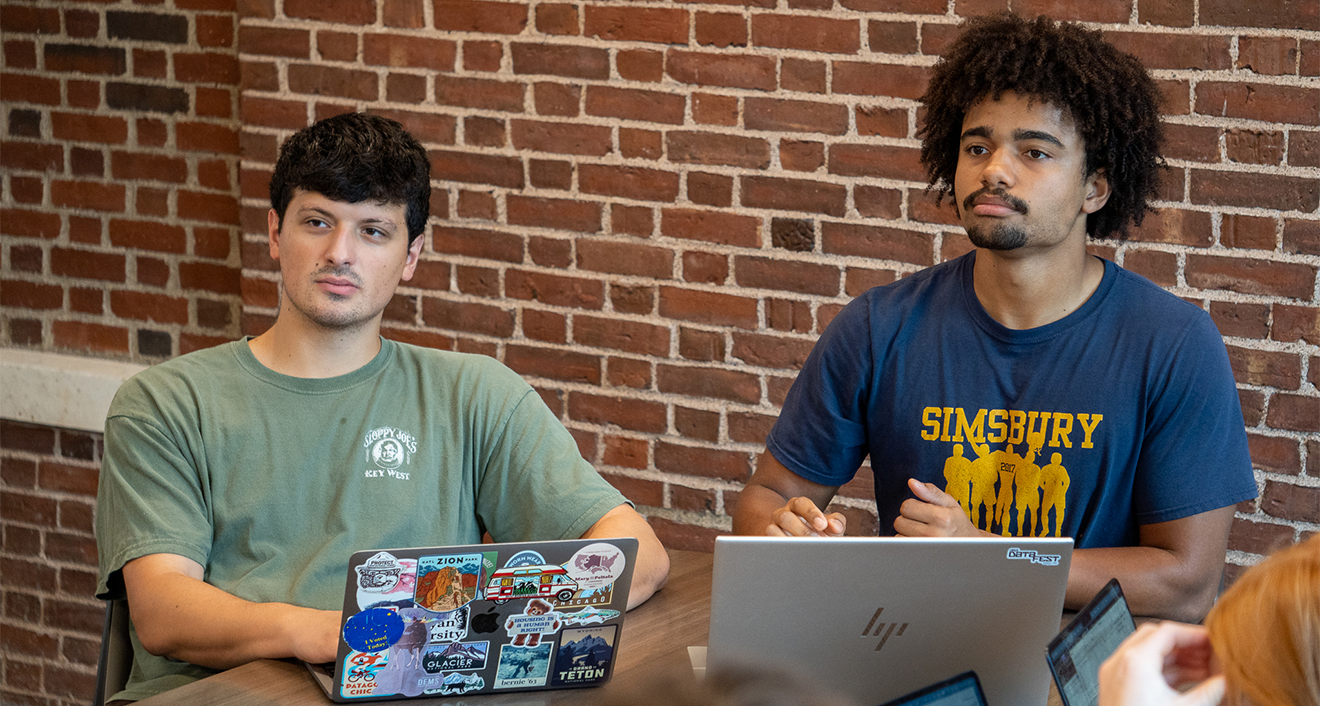
Vincent Lytle ’28, government major from Winnipeg, Manitoba, Canada, said he is researching how income affected the policy areas voters want the government to spend on. “I'm looking at all of these policy areas and seeing which ones move together and create natural groups of where people want spending done, then seeing if there's some kind of reasonable conclusion to make about it,” he said.
Lytle has done research in previous classes, but he said this class helped him think like a researcher. He said he tries “to go into things unbiased and being very critical of what I’m seeing and think about how I might be misrepresenting something or not accounting for something.” He plays for Wesleyan’s football team and wants to pursue a career in community development.
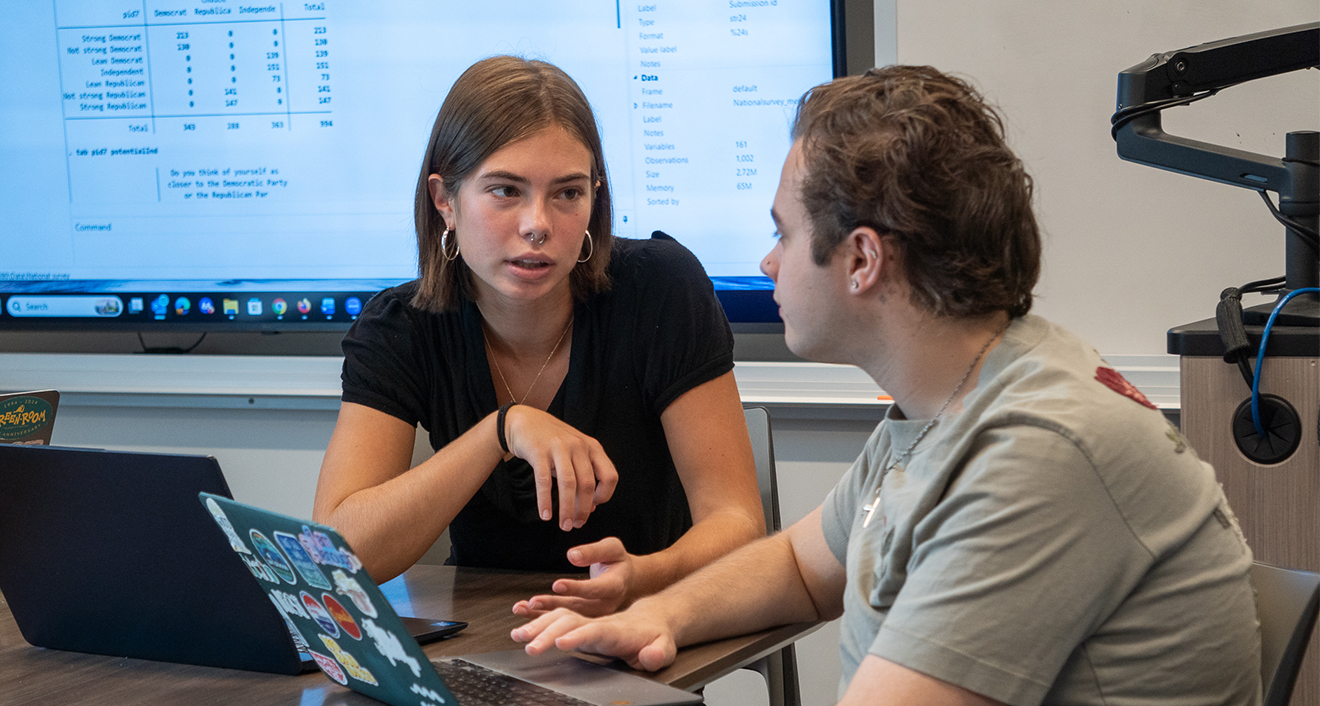
Natalie Shaw ’28, government and psychology double major, said working with a new dataset, especially one that’s timely ahead of an election, was exciting and motivating. “It's eye opening to have this real-life data; these are real people that are struggling because of government policies,” she said.
She said in this class she’s learned to take broad information and condense it in a way that’s understandable and beneficial for the public, as well as work through research setbacks without being discouraged.
Dancey said providing undergraduate students with access to research opportunities like this gives them a space to investigate and understand the complexity of social problems. “As you dive into any research, I think you often find that the answers to questions that you have are more complicated and nuanced than you might have anticipated,” Dancey said. “And that can be both fun, but also challenging.”