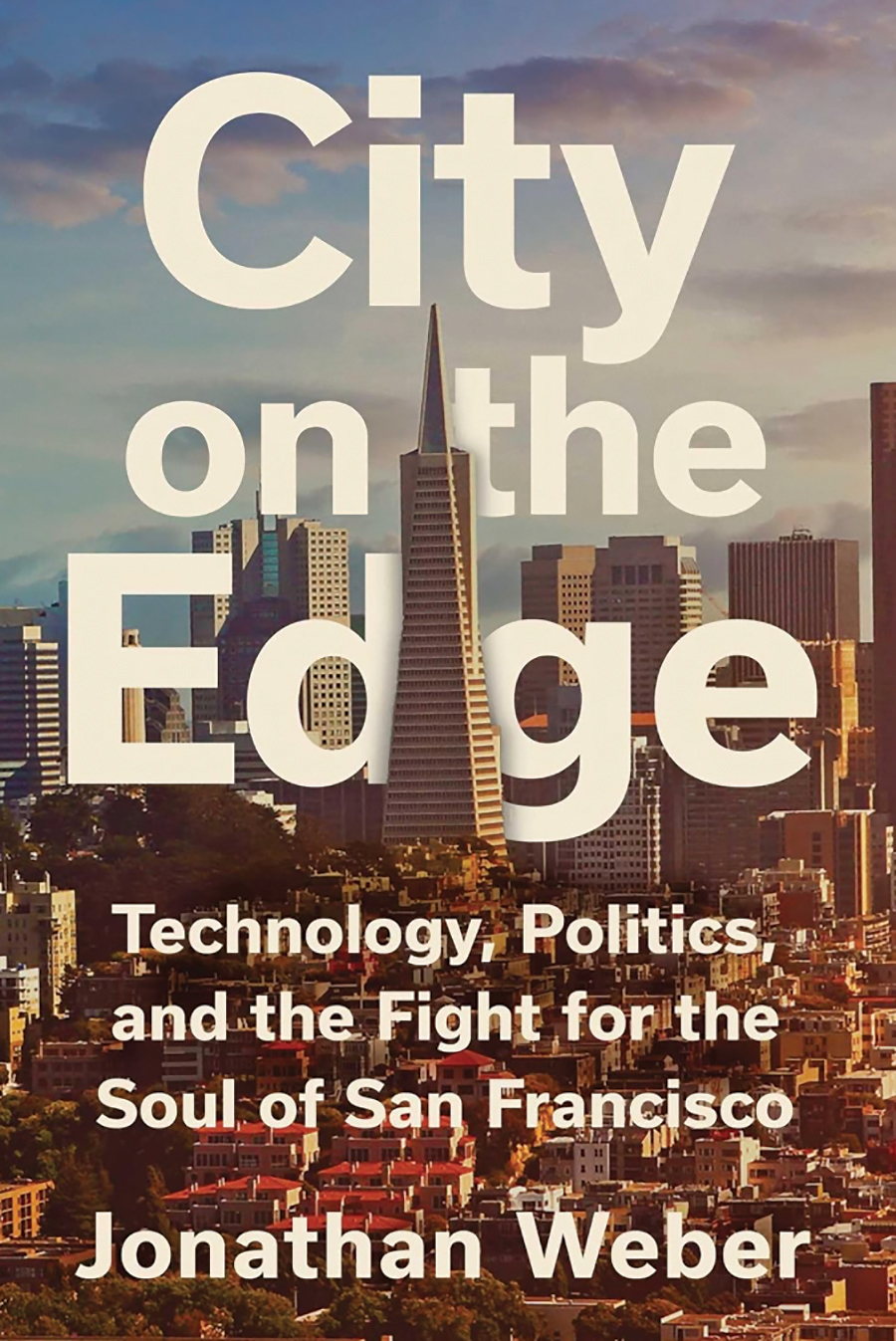
City on the Edge: Technology, Politics, and the Fight for the Soul of San Francisco: Book Review
In the story Americans tell about San Francisco, the city often appears as either a utopia or a warning sign: the birthplace of countercultural reinvention, technological optimism, and progressive politics, but also shorthand for the housing crisis, homelessness, inequality, and civic dysfunction. In City on the Edge: Technology, Politics, and the Fight for the Soul of San Francisco, Jonathan Weber ’82 complicates both images. He presents the city not as a static symbol, but as a living political organism shaped by boom and bust economics, ideological conflict, and the ambitions of people who arrived hoping to remake themselves and the world.
The book’s central argument is that San Francisco’s present crises cannot be understood through technology alone—the city is an unwieldy mammoth with overlapping functions and authorities. In an interview, Weber said one of the most common misunderstandings about the city is “this idea that Silicon Valley and San Francisco are one and the same, which is not really the case.” Though San Francisco is now often seen as the tech capital of the world, Weber emphasized that this has only transpired in “the last 20 years.” The tech boom did not create San Francisco’s tensions from nothing; instead, it collided with the city’s older culture, politics, and image. That collision makes San Francisco a place where immense wealth and radical idealism exist side by side, often uneasily.
Weber notes that a majority of his interviewees were not originally from the city, which truly goes to show that San Francisco is “a city that’s made in the way of people who came from somewhere else.” This openness to reinvention is one of the city’s great strengths, but it also makes San Francisco vulnerable to competing fantasies. Weber recalls entrepreneur Mark Pincus describing the city as “an idea in his head,” adding that “everybody has kind of this version of San Francisco that they invent for themselves.”
Weber synthesizes these mirages of the city in his book, refusing to reduce its conflicts to a simple battle between greedy tech companies and virtuous progressives—a myopia that makes it harder to address San Francisco’s real problems, from housing to fentanyl to public safety. As he put it, a crisis like fentanyl “is not a political issue” in any simple sense; it is a nuanced problem that will require people “to work together.”
A City on the Edge’s treatment of government shows how San Francisco’s problems come from success just as much as failure. Weber describes the city as a place of “exceptional economic boom times,” which inevitably makes San Francisco a “bust town” as well. Its creativity and innovation generate extraordinary booms, but governments, he says, are “not very good at forward planning” and tend to be reactive. Ballot initiatives, overlapping commissions, distributed authority, and competing interest groups make it difficult to achieve coherent government.
Weber’s authority on the subject of San Francisco comes from proximity. As a journalist and newsroom leader, he witnessed many of the city’s transformations up close. Still, the process of interviewing and reflecting forced him to confront the instability of memory. After conducting more than 200 interviews, Weber found that even people present at the same events often remembered them differently. In one case, after receiving “three different accounts of the same story,” he says, “I realized I had to just cut it.” This anecdotal quality is unique, turning the book into a reconstructed archive of holistic recollections.
Ultimately, City on the Edge portrays San Francisco as trapped between imagination and governance. Its greatest strength is its ability to attract people who believe the future can be invented there. Its greatest weakness is that it often lacks the structures to manage the consequences of that invention. Weber sees the current AI boom as a possible replay of earlier cycles: new money, rising costs, displacement, backlash, and eventual bust. For him, housing remains the crucial test. The city housing shortage and much of its zoning “precludes multifamily housing,” in Weber’s words. Whether San Francisco can overcome resistance to new housing may determine whether it is truly recovering or merely entering another phase of the same conflicts.