Wesleyan Alumni Put Science to Work for the Public Good
The 34th Annual Dwight L. Greene Symposium considered how science can work for the public good, how the liberal arts can empower Black, Indigenous, and People of Color (BIPOC) in the sciences, and the importance of self-advocacy and community support in improving access to the sciences. The conversation was part of Wesleyan’s broader celebration of the sciences on campus during Homecoming and Family Weekend 2026.
The panel, titled “Life Changing Science,” brought Mark Coleman ’90 and LaNell Williams ’15 into conversation in Memorial Chapel. Their discussion was introduced by President Michael S. Roth ’78 and moderated by Meng-ju “Renee” Sher ’07, associate professor of physics, who began the talk by asking the panelists to describe their journeys from Wesleyan to today, and to share an example of a breakthrough initiative that’s working for the public good.
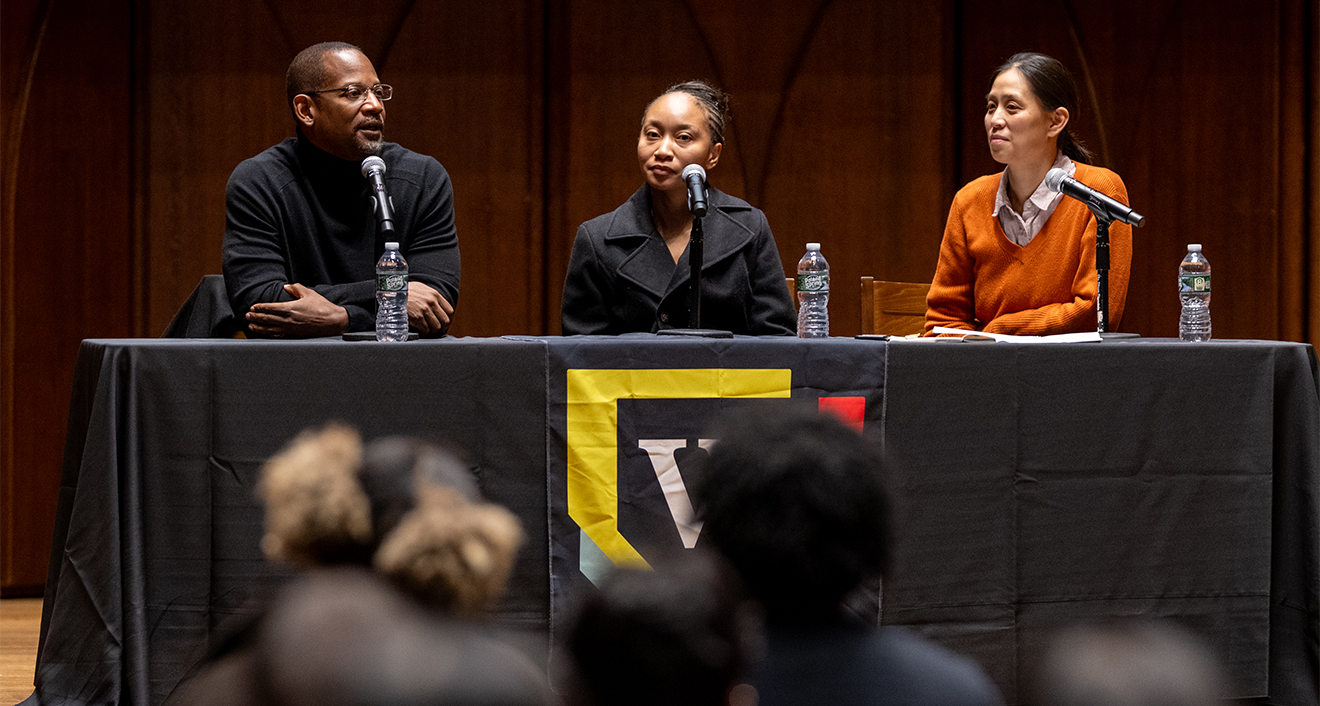
Coleman, director of clinical operations at the National Spine and Pain Centers, grew up around science as his father was an electrical engineer and his mother worked in a university biology department. He graduated with a degree in molecular biology and biochemistry from Wesleyan before earning his M.D. from Johns Hopkins. He co-founded Axsome Therapeutics, a company that develops new treatments for central nervous system conditions. At his company, one product they developed was a patch that provides relief for diabetes patients who experience burning sensations in their feet.
“It's a testimony to drug development, in the sense that from the idea to practical application was close to 15 years,” said Coleman, alluding to the extensive and arduous process for getting a medication to market. “There's a lot of funding that goes in and a lot of people have to stay with the mission.”
Williams, associate research scholar at Princeton University, is currently researching photosynthesis and how it could be used to teach plants to grow larger and faster in the hope of growing more food to address global food scarcity. “I really do want to be a part of science that actually makes a large impact,” she said. “The algorithm that I study is really important in thinking about how we can utilize solar synthesis to help solve our food scarcity problem.”
Unlike Coleman, she did not consider a career in science until her senior year of high school when she went to an engineering conference near Memphis, where she grew up. She then came to Wesleyan and graduated with a degree in physics, received her master’s in physics from Fisk University, and her Ph.D. in physics from Harvard University. She now studies the fundamental physics of biology processes, including photosynthesis and how viruses organize themselves.
Advocacy and Community
Once the two panelists described their backgrounds, the conversation shifted to a discussion of how to ensure that BIPOC individuals face as few hurdles when starting careers in the sciences.
Coleman said it starts with continuing to build intergenerational communities and connections among scientists of color. Those who are successful should reach back and help younger scientists succeed as well, he said. Williams agreed that networks like these are necessary but also raised that it’s important to teach students to advocate for themselves. She pointed to her own struggles as an undergraduate as an example. Williams found her entrance into science difficult, she said, because her high school left her less prepared than other students entering the physics major. At the time, she advocated for changes to high school-to-college transition support at Wes and she now passes the advocacy skills she used as a student here onto the undergraduates she works with at Princeton.
“I wish there was a way for us to share with the world the way in which folks from Wesleyan decide to tackle hard problems and advocate for these various things to create other opportunities when we go out into these other institutions,” she said.
The Dwight L. Greene Symposium honors Dwight L. Greene ’70 as a memorial and tribute to his life and work as a professor of law, mentor, and friend. The Alumni of Color Network and the Black Alumni Council sponsored this event.