
Wesleyan Remembers Annie Dillard
Annie Dillard, the distinguished author and former English faculty member from 1979 to 2001, passed away on September 15, 2026, at the age of 81.
Many detailed obituaries have been written about her in the past few days, including these published in the New York Times, Washington Post, and Los Angeles Times, as well as this piece in The Atlantic (written by Wes alum Isabel Fattal ’17) discussing what made her work so distinctive. Since so much has already been written about her life, we will focus here on personal reflections from former colleagues and students about her time at Wesleyan and her impact on their lives.
Phyllis Rose, Professor Emerita of English
The English Department in 1978 had a position for a visiting writer, occasioned by the retirement of the poet Richard Wilbur, who had graced the faculty for many years. The first person to occupy the new visiting position was V.S. Naipaul, who was with us 1978–79. The poet Mark Strand was hired for the second year. But Annie Dillard, who had previously declined the position, saying she was rooted in the Pacific Northwest, changed her mind and decided she wanted to move East. She talked Mark Strand into giving up half his job to her, arrived in Middletown, and turned the visiting position into a continuing one for herself. It was immediately clear that she was a jewel in the University’s crown—and also that she did not take no for an answer! Once you met Annie, it was hard to imagine doing without her. Certainly, her students felt that way. She was inspiring and demanding, peremptory and accessible. Students were welcomed at her house to play volleyball in the backyard or ping-pong in the living room. She played softball on Andrus Field with such enthusiasm that her knees were shot much too early in life. She was a magnificent writer, teacher, friend. We were lucky to have had her at Wesleyan for so long. And I can tell you, as someone who knew her well for 40 years, that she considered her time in Middletown the happiest time of her life.
William Stowe, Benjamin Waite Professor of the English Language, Emeritus
Annie Dillard was one of a kind, equally at home in the woods, a classroom, a softball field, or a song-and-dance party. She brightened and broadened life at Wesleyan for those students who were lucky enough to work with her and for colleagues from across the disciplines who came to value her friendship, her wit, and her deep commitment to writing as a way of knowing and shaping the world. Getting to know her was one of the great joys of my time there.
Elizabeth Graver ’86
Annie was part of what drew me to Wesleyan for college in 1982, as Pilgrim at Tinker Creek had dazzled me when I read it in high school. I boldly wrote to her during the summer before college, included a few poems I’d written, and asked if I could take her poetry workshop, and she wrote me back and let me in. She was sometimes harsh as a teacher and so intense in her manner that I could never quite look her in the eye, but her underlying encouragement of my writing in college and beyond was a vital gift. I remember returning to Wesleyan to give a reading after my first novel came out. Annie pulled me aside before I went up to the podium and firmly instructed me to not talk too fast. Then she said, “Listen, we know each other through my being your teacher and since then socially, but we also know each other through reading each other’s work. How do we know each other better?” “The work,” I said without hesitation, desperate to escape her gaze but also because it was, in some profound and moving way, so true. Annie smiled, thumped me on the back, and said, “Go gettum, girl!” I return so often to her sentences, and to her singular, luminous, exacting way of witnessing and speaking to the world.
Jake Silverstein ’98
Annie meant so much to so many people—her books changed countless readers’ lives, and those of us who were lucky enough to be her students were transformed by what she taught us about reading and writing and life. Has there ever been anyone more rigorous and more playful? She was both. She inspired you to go at your work with intensity and clarity, and at the same time to puncture all pieties with an impish grin. In American literature she is a towering figure; in the classroom she was intimate, intimidating, electric, and generous. Her home base at Wesleyan was a faculty house on Mount Vernon Street that was, for her students, a magical zone of teaching and fun. And she helped so many of us get on our feet and find our paths after we left that zone. I’ll miss her very much.
Maggie Nelson ’94
Annie Dillard was a force of nature—a singular human being who broke the mold on and off the page. Over her many years at Wesleyan, she was an impassioned, inspirational, often wild teacher, who made a mark on many students’ lives (including mine). In the years since her retirement, I often heard her say that she loved teaching more than nearly anything else she’d done. (Perhaps for this reason, she wished to be buried at Indian Hill Cemetery in Middletown.) Annie kept in touch with many former students, several of whom are working together to plan an East Coast memorial to honor her later this winter. We hope people will take this moment to pick up her work, be it for the first or the 100th time, and share in her amazement at being alive.
The University will provide details about the memorial once that information becomes available.
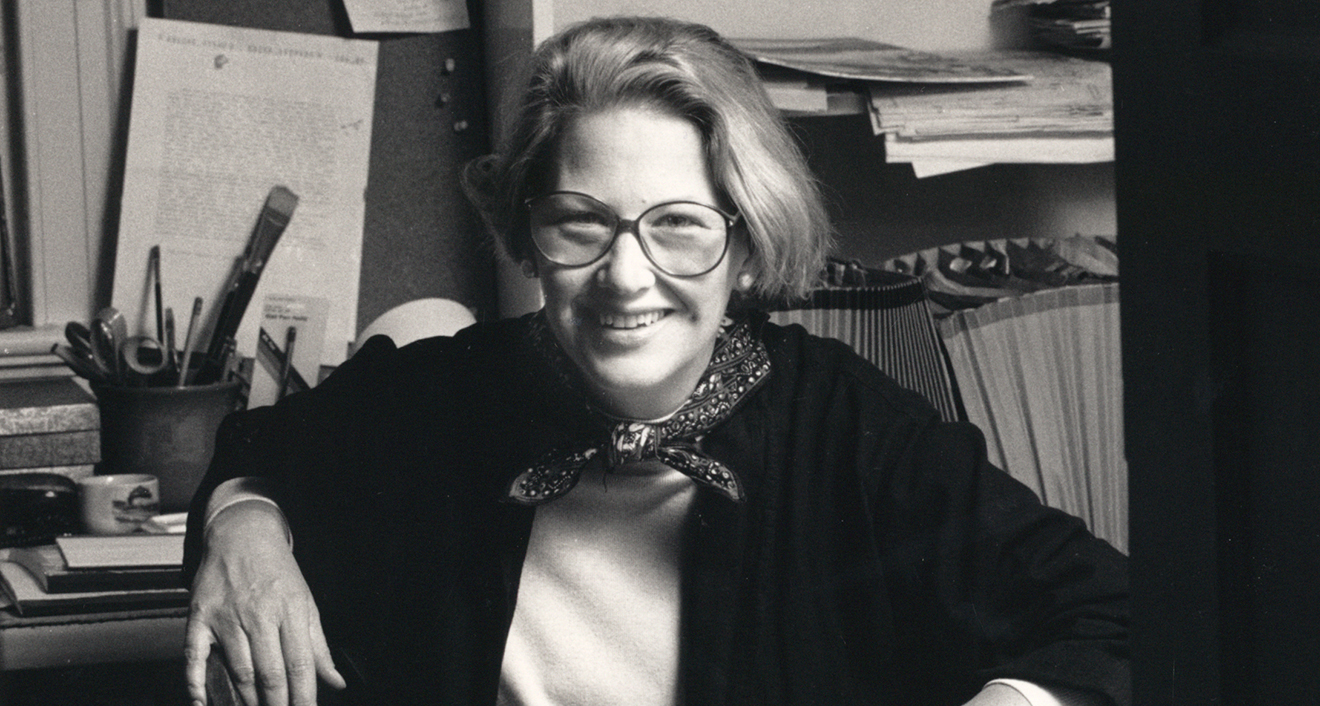
Photo courtesy Wesleyan University Special Collections & Archives.