
When Reproductive Care Gets Complicated: Jennifer Karlin ’99
Since the US Supreme Court issued its 2022 Dobbs v. Jackson Women’s Health Organization decision, access to reproductive health information and services has become increasingly difficult in large swaths of the nation. Today, with funding from the state of California and in partnership with University of California, San Francisco (UCSF) and the National Clinician Consultation Center (NCCC), Jennifer Karlin '99, MD, PhD, is helping fill those gaps through a new clinician-staffed hotline for sexual and reproductive health care providers across the country.
In 2024–2025, nearly a third of women ages 18–49 in America reported difficulties accessing reproductive health care.
The Reproductive Health Hotline (ReproHH), started by Karlin, answered its first call in late June 2025. Staffed by board-certified family and community medicine and obstetrics-gynecology doctors, each with at least 10 years of specialty experience, the hotline has answered about 350 calls in its first year. Calls came from providers nationwide seeking credible, updated information to assist in their clinical practice: How do you manage syphilis during pregnancy? If a patient vomits during a medication abortion, when is a repeat dose indicated? What’s the best contraception option for a patient with complex comorbidities?
“I believe that all primary care docs and advanced practice clinicians can do this kind of work,” says Karlin, a family and community medicine physician specializing in reproductive care access and complex family planning at UCSF. Primary care doctors are responsible for such a large scope of practice; keeping up with new evidence in sexual and reproductive health can be challenging, she says. “They just need the tools to be able to do it.”
A “Glaring Example” of Care Affected By Sociopolitical Factors
Growing up, Karlin had watched her mother navigate years of dismissive misdiagnoses before learning that she had an autoimmune disease. “Before they diagnosed her with systemic lupus erythematosus, doctors literally told her she was depressed that her daughter was going to college, and she should garden to help relieve her stress. Can you imagine people saying that to a man? That got me really, really curious about the ways in which doctors both learn to frame disease to people and how people then internalize those biases,” says Karlin, who double-majored in biology and the Science in Society Program while at Wesleyan.
That intellectual journey ultimately led her to an MD/PhD at the University of Chicago, where she studied the history of medicine through an anthropological lens before heading to UCSF to complete her medical residency in family and community medicine and, afterward, a fellowship in complex family planning.
“Reproductive and sexual health is such a glaring example of care that is affected so obviously by sociopolitical factors,” says Karlin. “Almost everyone [consults] a doctor about sexual and reproductive health concerns at some point during their lifetime. Given that an individual’s care is embedded in family and community structures, it could be seen as the keystone of family and community medicine. So, integrating a family- and community-centered approach to reproductive and sexual health became important for me.”
Following the Model of Previous Health Care Visionaries
During residency and fellowship at UCSF, Karlin encountered two enterprises that would become the model and inspiration for ReproHH. The National Clinician Consultation Center (NCCC) was founded in San Francisco by the late Ron Goldschmidt, MD, in the early 1990s to connect doctors to resources about HIV/AIDS during the height of the epidemic. Hotline staffers provided not only medical information, but also peer support in an era when many did not yet know that HIV was not transmissible through casual contact. “Brilliantly, Ron was like, not only does information that is being discovered in the epicenter of HIV/AIDS in San Francisco need to be disseminated, but practitioners should be able to call the health care providers doing this care so that they too know that they can provide it in their own health care settings across the country,” says Karlin, who became a Goldschmidt mentee. (Thirty years later, the federally funded NCCC continues to offer expertise on HIV/AIDS, hepatitis C, and substance use disorder.)
“Primary care doctors are responsible for such a large scope of practice; keeping up with new evidence in sexual and reproductive health can be challenging. They just need the tools to be able to do it.”
During her fellowship, Karlin was part of the team that in 2019 founded the Miscarriage and Abortion Hotline, a service that provides information to patients self-managing either of the two experiences without direct medical supervision. The following year, COVID-19 stay-at-home orders led to a rapid increase in telehealth and home management of conditions that previously relied on in-person clinic visits. Then, there are the broader consequences of Dobbs v. Jackson Women’s Health Organization, which overturned the federal right to abortion. In 2024–2025, nearly a third of women ages 18–49 in America reported difficulties accessing reproductive health care, according to the Reproductive Health Experiences and Access survey. As calls increased by 210% leading up to and following the Dobbs decision, the Miscarriage and Abortion Hotline staffers started noticing that they weren’t just talking to patients: Doctors were starting to call seeking information.
“We needed a hotline that supported health care providers nationally in evidence-based information around reproductive health,” she says.
Expanding Access to Evidence-Based Care
In 2024, after working as associate director of premedical education at UC Davis, Karlin returned to UCSF to lead the launch of ReproHH under the auspices of UCSF’s Department of Family and Community Medicine and in partnership with the NCCC. ReproHH was one of five programs funded by a $120 million state budget appropriation made in 2022, seeking to reaffirm California’s commitment to reproductive rights and care access. It is state-funded until 2029 and has operating funds through 2030.While funded through California's response to Dobbs, Karlin says ReproHH is addressing gaps that long predated the decision and will persist regardless of future legal or political changes. In its first year, call data showed that clinicians sought expert consultation not only for abortion and contraceptive care but also for sexually transmitted infections, menstrual disorders, menopause, fertility, and other reproductive health concerns encountered every day in primary care. By helping clinicians care for patients where they already seek care, ReproHH expands access to evidence-based expertise and may help reduce unnecessary referrals by enabling clinicians to manage their patients locally.
“We needed a hotline that supported health care providers nationally in evidence-based information around reproductive health.”
Doctors at ReproHH answer about 15 calls a week (with capacity for more) from health care professionals nationwide—nearly 60 percent of them calling from outside California. More than half of the clinicians who called the hotline work in community health centers and clinics. Answering the call is always an actual person. “In an age of AI,” Karlin says, “hotlines that are actually backed by humans are so important. Callers want to know that the information is evidence-based and correct, and that the person on the other line has stood in their shoes.”
In fact, most of ReproHH’s calls in its first year—about a quarter—were about sexually transmitted infections, with menstrual and abnormal uterine bleeding a close second; this differed from the pre-launch needs assessment, Karlin says, which showed contraception to be the most likely caller topic. Callers reach a clinician within 90 seconds, and the hotline takes deliberate steps to ensure caller confidentiality. The hotline does not take direct calls from patients, nor does it offer referrals or legal advice. “We’re providing an educational service, but we’ve gone above and beyond to protect both our staff and the people calling in,” Karlin says. “All the phone numbers are scrambled on the way in, and we don’t take down any [private medical information], and everything is anonymous.”
As for the clinicians who contact them, they’re often overextended and exhausted from navigating new evidence as well as the potentially dire consequences—for their patients, for themselves—of providing reproductive health services, be it as their primary calling or to fill in mounting care gaps. Setting aside time to call a hotline might seem like yet another cumbersome task. But “once someone calls, they're like, ‘Oh my god, that was so amazing—easy and fast,’” says Karlin. At a moment when reproductive health care is defined by uncertainty, an informed voice sounds like a relief.
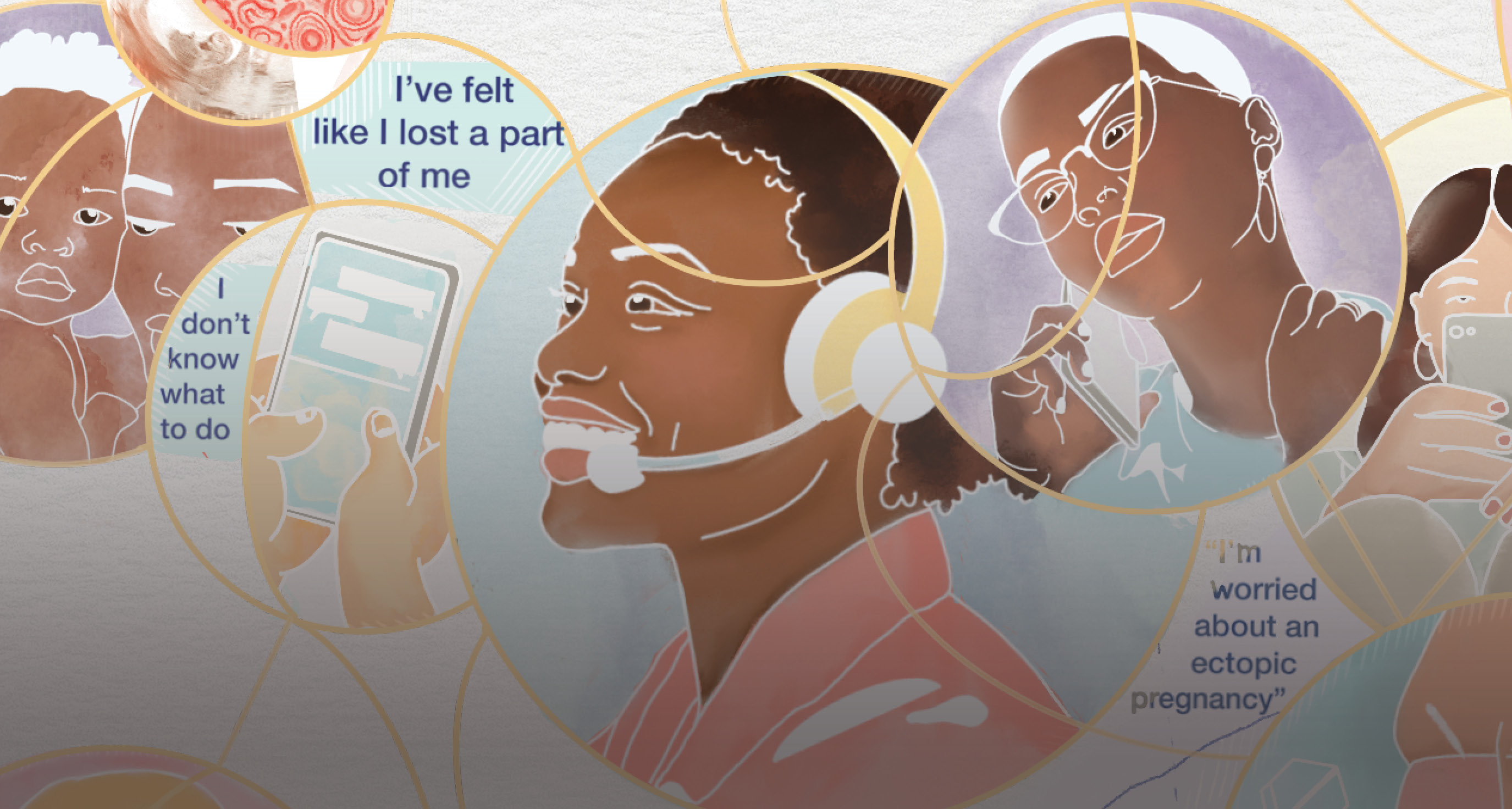
Illustration by Emma Hernandez; www.xilindrina.com